Observation
For some small tumors without growth, a clinician may recommend follow-up MRI scans to monitor for change.
Ask: What follow-up schedule should I use, and what changes would lead us to reconsider treatment?
Learn / Prepare
An acoustic neuroma, or vestibular schwannoma, is a usually slow-growing, noncancerous tumor near the hearing and balance nerves. Your specialist can explain what your scans and hearing tests mean for you.
General education only. No treatment is best for everyone, and a patient story cannot predict your outcome.
Source: NIDCD: vestibular schwannoma
Anatomy / Orientation
A vestibular schwannoma typically begins on the vestibular—or balance—branch of cranial nerve VIII. The cochlear branch, which carries hearing signals, travels beside it through the narrow internal auditory canal. Hearing changes associated with these tumors do not have one proven explanation.
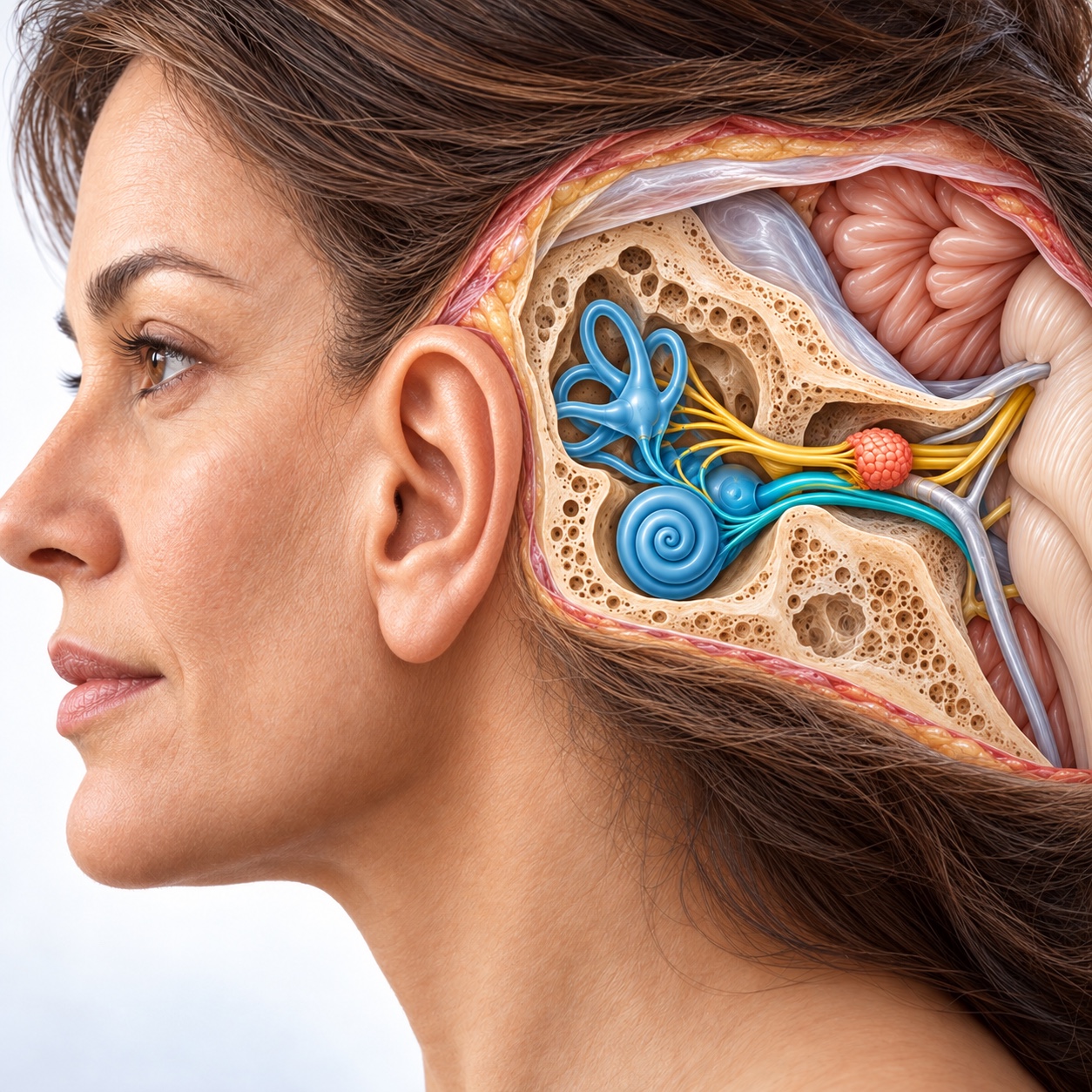
The spiral-shaped part of the inner ear changes sound vibrations into signals the brain can interpret.
The semicircular canals and related structures help detect movement and support balance.
Shown in teal. This branch carries hearing information from the cochlea toward the brain.
Shown in gold. Vestibular schwannomas most often arise from this part of cranial nerve VIII.
Shown in silver-gray. Cranial nerve VII passes through the same narrow area but remains a separate nerve.
This bony passage carries the hearing, balance, and facial nerves between the inner ear and brain.
Shown in coral. MRI identifies its actual side, size, location, and relationship to nearby structures.
The nerves travel toward the brainstem. Larger tumors may extend into the nearby cerebellopontine-angle space.
Sources: NIDCD overview, systematic review of proposed hearing-loss mechanisms, 2025 study of tumor-secreted inflammatory factors, and the University of Iowa surgical protocol.
Daily life / Practical support
Experiences vary. Use these pathways to find practical information for symptoms, communication, relationships, work or duty, and the uncertainty that can come with ongoing care.
Speech clarity, noisy rooms, sound direction, devices, and communication strategies.
Explore hearing supportRinging or other sounds that may affect sleep, concentration, and stress.
Explore tinnitus supportUnsteadiness, motion sensitivity, safety planning, and vestibular rehabilitation.
Explore balance supportHearing effort, poor sleep, stress, headaches, and the mental load of adapting.
Explore fatigue supportDescribe the affected tasks and plan for appointments, travel, recovery, and accommodations.
Plan for work or dutyFear, sadness, isolation, information overload, and ways to ask for support.
Explore emotional supportCommunication, appointments, practical planning, and support without assumptions.
Open the family guideOrganize records, prepare questions, and identify the next step with your care team.
Open the diagnosis roadmapSymptoms such as hearing loss, tinnitus, dizziness, headaches, fatigue, or concentration changes can have causes other than acoustic neuroma. A clinician must assess new or changing symptoms.
For some small tumors without growth, a clinician may recommend follow-up MRI scans to monitor for change.
Ask: What follow-up schedule should I use, and what changes would lead us to reconsider treatment?
Focused radiation, sometimes called radiosurgery, can be used to limit tumor growth. It does not involve a surgical incision.
Ask: What are the expected benefits, hearing risks, and follow-up needs in my case?
Surgery removes tumor tissue. The approach depends on factors such as tumor size and hearing. Hearing, balance, and facial nerves can be affected.
Ask: Why this approach, and what might recovery involve for me?
This checklist is for your own preparation. Ticks are temporary and are not submitted or saved by this site. Use your browser’s print option for a paper copy.
It means noncancerous. A tumor near hearing and balance nerves can still have important effects. Ask your clinician to explain your individual findings.
Yes. Discuss your current hearing and the hearing-related risks of each option with your specialist. Do not assume that controlling or removing the tumor will restore hearing.
Ask what their situation was and what questions helped them. Keep your own treatment decision with your clinical team; online stories are individual experiences, not comparative evidence.